Thursday, May 19, 2016

Biochar to Improve Soil Drainage and Save the Bay

In Maryland, the Environmental Site Design (ESD) standard for water runoff is that it should mimic woods in good condition. This is difficult when impervious surfaces are being added, since the water collected and treated in stormwater management devices must then exceed what would be impeded and filtered if woodlands completely covered the unbuilt portions of the site, i.e. the additional effectiveness required increases with the amount of impervious surface introduced. The Design Manual qualifies the standard to require that it be achieved to the Maximum Extent Practicable (MEP). This is not as big of an escape clause as it may appear, since the manual also includes a checklist that helps determine whether the design process demonstrates a sincere MEP effort.

The idea of using wooded areas as the standard for all sites is very suitable for Maryland, as a glance at Google Earth will show how very wooded our state is. Yet, rumor has it that the next update to the manual will not be so stringent. As it is, the absolute minimum standard already obviates the wooded area criteria, if it turns out to be impractical on any given site. That minimum standard in the eastern part of Maryland is to design stormwater devices to hold an amount based on 1" of rainfall, ensuring that a specified portion of that water volume drains into the ground to recharge the aquifer. I hope they hold to the more rigorous ESD standard because the Chesapeake Bay will flourish if we can insulate it from the effects of our exploits on the land.

Photo by Birgit Speulman (CC BY-NC-SA 2.0)
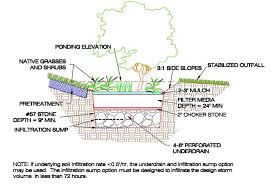
Deep biochar-soil mixtures in planting beds would be an effective way to improve drainage, thus helping to meet the recharge volume requirement. Wet ponds are preferred to dry ponds, but you get less aquifer recharging since the water drains slowly in a wet pond. What you could do is use biochar to improve drainage of combination pond forebays, possibly allowing smaller overall pond size.

Here in Southern Maryland, we have a lot of Beltsville soils which are typified by a fragipan layer that is practically impenetrable. It may even reform after being broken up. Here again, biochar could help if it could be injected in fragipan layer breaches, preventing it from reforming. For the gardener, this might involve digging with a post hole digger and dropping biochar into smaller holes that have been chiseled through the fragipan. This would improve drainage considerably and, if the biochar was inoculated first and enough added, eventually eliminate the fragipan through microbial action.

Monday, May 16, 2016

Storming and Norming lead to Underperforming

Just from my brief exposure so far, I have concluded that the management of stormwater runoff is typical of our engineered environment in that much effort is put into the design and construction of a device, after which ensues a lifetime of neglect. It's not due to lack of regulation or even oversight, but a lack of attention by owners and a failure of governance. A well constructed stormwater pond can degrade due to erosion, poor control of vegetation, or flowpath blockages and remain that way for years, all the while earning its full TMDL credit, though performing only half as well as it should. The local authorities are loath to penalize or even notify violators of their maintenance obligations out of fear of having a negative economic impact on business. State and federal enforcers are just as remiss.

Now that Environmental Site Design has downscaled the control of stormwater to smaller devices spread throughout a new development site, it will be interesting to see whether things will be better maintained due to aesthetics and scale. Education will be key. Fortunately, the Design Manual spells out the maintenance requirements for each device type.

Here's the type of problems that degrade a stormwater pond. The photo here is from a place I frequent that has not been maintained much for about 5 years. Trees grow on embankments where the roots compromise the dam's ability to hold water. Banks are eroded into the pond, reducing the vegetation inside, causing pooling of water, and reducing the overall pond capacity. Cut trees are left inside the pond, putting more nitrogen into the watershed as they decay. I hope to catalogue many stormwater devices such as this in Calvert County over the coming months and use this in presentations to those who need to know. They will be posted on my newest tab on this blogger site.

Friday, May 13, 2016

The Grass is Always Greener when You Can Sell It

3-inch deep hardwood mulch extends 3-feet
beyond the dripline of our cherry tree
When my Watershed Stewards Academy instructor blithely offered that we should stop cutting our lawn grass for the sake of better nutrient and water retention I wasn't sure if she meant stop entirely or just let it grow longer than normal. I suspect the latter, which would also support the outside-the-box idea proposed by Gene Logsdon to grow fodder crops in lieu of turf. In my case, there is only a small area remaining on my property that would lend itself to grass. I went the conservation landscaping route a year ago and my mowing duties have been minimal since.

I've been thinking of planting grass on the strip remaining in front of my Kentucky fence. I've also been trying to come up with a good guerilla gardening idea for the right-of-way that fronts the forested lot under the power lines running on the far side of my street. Aside from the black raspberry plant I stuck there last week, this just might be the best way to go.

Growing long grass will push the limit on the HOA's rules, but if I'm going to use that grass for fodder, so would keeping a barnyard animal. Until I get to that level, I'm sure there will be someone in my circles who would appreciate the extra feed. It would also serve well as a compost activator.

Tuesday, May 10, 2016

An Offer You Can't Refuse

Earthworks like swales are ways to direct and slow the flow of surface water, but the low hanging fruit for livestock farmers to reduce nutrient flows into the Bay is installation of riparian buffers. That is, they should build fences to exclude grazing livestock from access to streams. If they want to save on a big fence bill and have an even more helpful result, they should consider rotational grazing. In any case, simple fences that allow wildlife to get through are an important feature.

The Best Management Practice (BMP) with the next highest potential to achieve TMDLs is conservation tillage, which includes no till and minimum till. When you include biochar as a soil amendment (not yet recognized as a BMP, but deserves that distinction), humus formation is accelerated by perhaps a factor of 10. Conservation tillage relies on humus and plants to make up for the absence of artificial soil aeration. As the years go by, such soil-building measures make it possible to reduce fertilizer additions to zero.

Biochar would also be useful just for its filtering ability in such devices as micro bioretention ponds and ditches. Specifications for these includes 2 feet of sandy soil, but a smaller amount of biochar could provide the same drainage and many times the nutrient filtering of the current designs. It would also yield better plant root growth than just sandy soil.

+Paul Stamets used buried burlap sacks loaded with mycelium to filter runoff from his property. It worked so well, it amazed the government inspectors who came to see the results.

These are all examples of how more effective measures are possible, but not promoted by the bureaucracy, since such official prescriptions such as the Maryland Environmental Site Design Manual don't recognize them. As the 2025 deadline for Chesapeake Bay TMDLs approaches too soon for the counties and states to clean up their watersheds, they are going to want to be able to claim the improvements that mycelium and biochar offer over existing practices.

Saturday, May 7, 2016

Too Big to Swale

Fortunately (and wittingly) we have avoided major overflow incidents from wastewater treatment plants here in Maryland for the past several years. Easier to overlook (and we have) are nonpoint sources of water pollution, which are classified as agricultural, urban, forest, and rural, i.e. septic systems. We have become pretty wise to containing hazardous materials, but the pollutants that are choking our bays and rivers with algae are everyday elements carried in the water seeping through or running over the land. There are over 500 potential water pollutants managed in various parts of Maryland, but one ubiquitous element, nitrogen, is the major problem nutrient feeding the algae invasion of our tidal waters.
Photo by Neil Williamson (CC BY-SA 2.0)
Agriculture is the largest contributor to nitrogen pollution and likely to remain so for many years. This could be because agriculture has consolidated its operations disproportionately to its proper ecological scale. Farms these days, in spite of their vast acreage, are generally family operations. Driven by globalization, agriculture has become a very competitive industry, so much that Maryland farmers would not settle for local administration of their part of the Total Maximum Daily Load (TMDL). They needed more consistent application of the standards that constitute the nutrient diet for the Bay, so TMDL for agriculture is managed at the state level.

However, it is the counties who are responsible for their reducing all of their nutrient flows (including agriculture) below set targets or risk losing their federal funding for infrastructure. In other words, the counties have accountability, but no authority for the behavior of their agricultural sectors. It should be no surprise that they have to shoot beyond their targets in the other sectors in order to make up for the lack of progress by agriculture. (I only have data from St. Mary's County, but am assuming that this subversion of local authority has the same effect everywhere.)

Am I being unfair to the agristocracy? Don't I realize they are working hard to make sure I don't go to bed hungry? No. If anybody has been unfair to them, it's the drafters of the TMDL limits. If those limits are unrealistic or biased, they should be changed. Until then, I'm sticking with my view that Ag is too big to swale and follow other Best Management Practices (BMP's) in fulfillment of their responsibility to help clean up the Bay.


Wednesday, May 4, 2016

Saving the Bay with Sewage

With the increase in heavy rain events (the past two weeks here, for example), the chances of having a wastewater treatment plant overflow to the watershed are growing. These incidents occur often enough for us to understand how devastating they are to the Chesapeake Bay and its tributaries. All of the efforts going into reduce nonpoint source pollution can be obviated in a day by the point source pollution of a major overflow incident. Reporting of incidents is easy to check on the state's database.

Nonetheless, the suggestions by the University of Maryland's Center for Environmental Science to reverse a decades-long trend of deteriorating conditions in Calvert County's tidal waters still emphasized nonpoint source measures, such as upgrades to septic systems and riparian buffers. That's where I come in, as perhaps the first Master Watershed Steward in Calvert County (once I complete the Watershed Steward's Academy this fall and capstone project sometime next year). The role of a Watershed Steward is to educate residents and encourage measures to mitigate nonpoint source pollution of the watershed.

Aside from the usual arsenal of methods to correct various nonpoint source problems, I'm hoping to introduce biochar in buried compost filters and bunker spawn in future projects.

Photo by sandwichgirl  (CC BY-NC-ND 2.0)
Back on the topic of wastewater treatment, Biocharo  (+Kathleen Draper) posted her ideas for the top ten ways to scale up biochar production without inviting deforestation.  The number one underutilized feedstock is sewage sludge. Here in Calvert County, our dried sewage sludge is trucked off to Virginia where they find a way to turn it into fertilizer. While there may be some pollution problems with that approach, making the sludge into biochar should correct them. Not only that, we could use county-owned land right near the Appeal sewage treatment plant to set up a pyrolysis facility. Combined with pyrolysis of yard and lumber waste, this would give the county a growing income stream and save on trucking costs of sludge sent off to Virginia. Even if the local agricultural market isn't ready for it by then, there is plenty of use we could make of biochar as a stormwater management tool, while getting carbon sequestration credit for the state's greenhouse gas reduction plan.

Sunday, May 1, 2016

No Free Lunch

Here in the 19th wealthiest county in the nation, we are without a metropolitan area unless you count the piece where I live, which is lumped together with part of St. Mary's county. We have a lot of farms in either county, so there should be no lack of wholesome food.

That being the case, what is behind the long-standing campaigns to grow and distribute free food to the "hunger community" in our area? Do such organized efforts alleviate long-term poverty? Do they invite outsiders desperate for food?

Two programs that stand out most are Farming4Hunger and End Hunger in Calvert County. Farming4Hunger appears to have the more honest appellation, since hunger might be a product of their efforts. Ending hunger is, of course, impossible and disingenuous as a campaign name.

The phrase "hunger community" is used in the annual report of Farming4Hunger and smacks of a caste system that implies separation of persons who rely on handouts for food. Joining the hunger community could enable a person to leave aside at least some of their struggle for basic necessities and enjoy some of the finer pleasures of life such as a home, a car, and pets.

Wait..., did I just say that a home, car, and pets are not necessities? Millions of Syrians and other migrants have come to that conclusion. The pets actually were probably temporary necessities for a meal or two, but the home and car were left behind, becoming aspirations once again as raw survival became the prime motivator.

The struggles of these refugees will go on for decades,
Photo by Stu Mayhew (CC BY-NC-ND 2.0)
mainly so their children may enjoy a better life. The irony is that many of them have a better chance of dealing with the economic turmoil ahead than the staid classes among whom they have infiltrated. What of those here in the 19th richest county in the USA who are insulated from those hardships. Will their children know how to dig themselves out?

Stasis. That is what is behind food giveaways. We want big ag to continue, so we have programs like Farming4Hunger that says the way to get food is through farming as we know it, and supports farmers who can't sell part of their crop on the market. We want people to think well of our charity, either as churches or corporations, so we sponsor programs like End Hunger in Calvert County which should be looking for ways to put themselves out of business, but seem interested in endless growth.

This stasis will not bring stability. Our current food system and growth paradigm is unsustainable. People need to be taught how to grow food and protect the soil. Those things, in themselves, are a struggle for anyone, but there's really no free lunch.

Featured Post

Git 'er Done

By Mark Rain T o get them all done in time to avert ecological armageddon, the thirteen prescriptions for healing the planet offered by...