Showing posts with label biochar. Show all posts

Tuesday, July 17, 2018

The Coming Scramble for Survival


Necessity is the midwife of devolution. Invention's mother is running out of resources, so she is reverting to the tried and tested. Her next brood will be a passel of low-tech survival tools. System design and implementation takes about a decade and that is about all the time we have before nature puts her foot down (if the rate of Arctic sea ice melt is a reliable leading indicator). The rate of ocean warming will increase promptly after the ice is gone. Coastal cities will experience a markedly more rapid increase in flooding events. It will finally become clear to the man on the street that we haven't done what it takes to turn the tide and cannot spend another decade working on it. The new systems that we could have had ready to withdraw CO2 from the atmosphere will not be available in sufficient quantities to prevent a great die-off. Suffering will move people to act individually and locally and one of the only negative CO2 tools available to the average Joe will be the biochar that they can make on their own. Enduring the diminished resource future will, however, carry the built-in solution of doing less of what has long been damaging the climate. 
Below, a list from Drawdown.org shows 71 solutions before it gets to biochar, about one-third of which are scalable to the human individual level. Collective activity won't entirely cease and the ultra-wealthy will still be able to command some sizeable projects, but beyond what takes place in the next few years, there won't be much civic initiative to avoid the continuation of today's burgeoning apocalyptic chain-of-events. Debt levels keep rising and all it will take is a crisis for everything to collapse in a way that will take a century or more to heal. Some places "get it" more than others, though, so living in a state governed by the cognoscenti may allow some of today's heroes to continue a more efficacious collective fight against global warming into the next saeculum. If so, a few people may survive to perpetuate the human species.
1
2
3
4
5
6
7
8
9
10
11
12
13
14
15
16
17
18
19
20
21
22
23
24
25
26
27
28
29
30
31
32
33
34
35
36
37
38
39
40
41
42
43
44
45
46
47
48
49
50
51
52
53
54
55
56
57
58
59
60
61
62
63
64
65
66
67
68
69
70
71
72
73
74
75
76
77
77
77
78
79
80

Friday, February 23, 2018

Buying Time

When you hear the name, "Doomsday Clock," of the gauge used by the Bulletin of the Atomic Scientists to warn that the end is nigh, it leads you to think that these scientists are doomers. Scientists are actually some of the most optimistic people. The Scientists are using the clock to show how modern civilization is flirting with widespread disaster and permanent collapse. The latest developments put our risk as high as it has ever been.

What the doomsday clock is purporting to show is that we are not doomed (yet). Were the clock to ever reach midnight, we would be. The clock currently tells us that we are nearing the brink, but climate change can still be reversed in time and  nations can still control the nuclear genie. James Anderson, a professor of atmospheric chemistry at Harvard who earned his stripes by pointing out how chlorofluorocarbons were depleting the ozone layer, tells us that there is much less time than we would like to believe.

According to Anderson, the Arctic ice cap is on pace to melt entirely by 2023. When that goes, the permafrost will melt, a tipping point which is not included in IPCC models. As the Greenland ice sheet slides into the ocean, sea level rises 23 feet. Anderson maintains that stopping greenhouse gas emissions is not by itself enough to prevent these near-term changes to Earth's systems. He calls for an all out effort to direct resources toward drawing down atmospheric carbon with some added geoengineering in the form of deflecting sunlight from the poles.

Let governments and institutions do what they will. I doubt they will transform industry as quickly as Professor Anderson says is needed. For those of my generation who are retired, who are not involved in the major muscle movements to end fossil fuel use and draw down carbon, I encourage you to learn how to make and use biochar. It's catching fire around the world and may be one thing that buys the world more time to realize its predicament and make decisions that will allow humankind to continue to dwell upon the earth.

Friday, February 9, 2018

Sounding Off in Desperation

Let's give this another go. Editing the International Biochar Initiative Newsletter, including a monthly summary of new research, has edged blogging out of my schedule of late, but I plan to reapply myself to posting regularly, becoming a writer again, rather than just an editor.

With a new title more descriptive of this blog's emergent zeitgeist, a new layout, and increased realization of how the world works, I plan to continue opining on developments from the perspective of my own (mostly potential) involvement. To be more specific about my involvement, of the 231 posts I have written, I can claim only one (dealing with my small scale biochar production) to be substantially realized in practice. Sixty-six posts deal with matters that I have not attended to in the least. The other 164 posts have received some attention, but still require much more.

A variation of Murphy's Law that I have subscribed to most of my life is that if anything can go wrong, it will, but the inevitability of such an occurrence diminishes significantly if you do something to prevent it. Even awareness of problems and needed improvements counts to some degree - taking the issues out of the unknown-unknown category. So I have 66 known-unknowns and 165 known-somewhat knowns now that still could use additional action. Those that I will concentrate on personally will come from the 66 in which I am most remiss.

Then there are the unknown-unknowns. These will hopefully be discovered in time as this blog continues meandering, albeit more desperately, in search of giving us a better chance.


Thursday, December 14, 2017

Anchara

If phragmites australis were to be charred under a cover of dredge spoils, the affected area could be immediately nitrogen-deficient due to the loss of N gas in the exhaust. Dredge material from upstream of the Conowingo Dam is nitrogen-rich, however, and the underlying soil would also contain great amounts of nitrogen which could wash up into the biochar. The heat of charring could even create microsites of char from the organic matter mixed in with the dredge spoils.

Nitrogen that was held in the reeds and added organic matter could be entrapped by the sediment casing, making it available when subsequent planting takes place (as with ankara practiced in Cameroon). Nitrogen that is trapped in the sediment cover or char due to an increase of reactive sites on clay or biochar could be sequestered, avoiding the greenhouse gas release or eutrophication that would accompany simply dumping of the spoils on the shore. Inoculating seedling roots with mycorrhizal fungi would be a very helpful step. If native legumes or other nitrogen-fixing species can be found, planting their seedlings preceded by a dip in the proper bacterial inoculum could be all it takes to jump start the nitrogen cycle after charring. Plants that are easy to grow would be necessary in any case, since the soil would be otherwise devoid of microbes. The roots should be placed no deeper than the baked sediment layer, though the underlying baked sediment should be broken up to allow the roots to grow into the charred phragmites layer.

One currently followed method of phragmites eradication is described in this brochure and a more interesting slideshow. It may be less expensive than my method, but it is potentially more harmful to the environment (glyphosate) and takes two years to reach the point of replanting or initial restoration. My method can be performed in a matter of weeks and it sequesters carbon while recycling dredge spoils. Since applying glyphosate must be done in a way that avoids overspray and contacts all the targeted foliage, current methods may also be more labor intensive (adding expense) and pose a health hazard to the exterminators.

Another common method of eradicating phragmites involves burning in addition to herbicides. This video shows what a good tinder phragmites is. My covered method would be more controlled and hopefully much less smoky.


Thursday, December 7, 2017

Demonstration Projects

Though installing rock dams at the outfalls to my local lake will require a lot of preparing, planning, organizing, and coordinating, my higher ambition involves another dam, also affecting the Chesapeake Bay, but to a much greater extent. Tomorrow the Maryland Environmental Service (MES) will begin evaluating bids for the contract competition to dredge 25,000 cubic yards of sediment from the Maryland portion of the Susquehanna River upstream of the Conowingo Dam and recycling the dredge spoils in an innovative fashion. The idea is to select a company that offers a promising plan for disposal of 1,000 times this much sediment by using this contract as a demonstration of how it can be accomplished on a small scale.

Conowingo Dam photo by Aaron Harrington
I am not in the dredging business, but the amount of dredge spoils requiring disposal from this dam  could be an ideal opportunity for me to try my idea for phragmites eradication. A successful small scale grant-funded demonstration would be a good way to gain the interest of MES and whichever compan(ies) they eventually award contract(s) totalling $3 billion. Before I even seek a grant,  backyard experimentation with charring under earth and/or sediment cover would be a good first step. Once I finish building my cob oven, I will be able to practice a few techniques, but will eventually want to replicate charring of dry grasses using a configuration like that in my eradication concept.

On top of that, following a year of training and practice, I am happy to report that tonight I got my certificate naming me a Master Watershed Steward. And I got the t-shirt. That oughta make 'em sit up and pay attention to my ideas on saving the bay.

Thursday, November 9, 2017

AFOLU

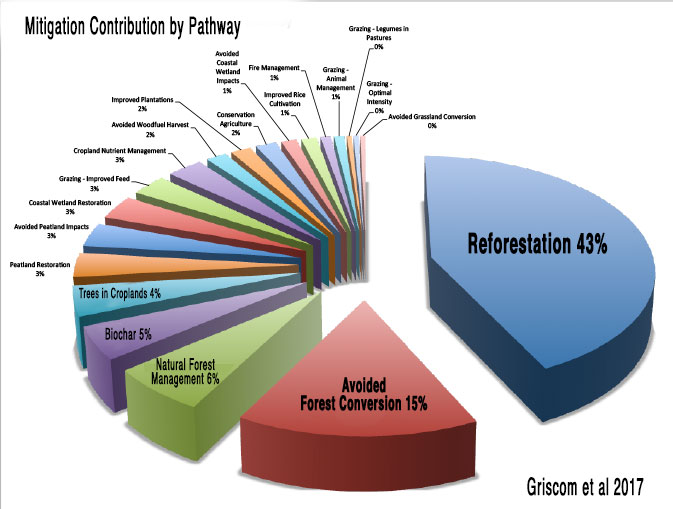
Leading up to COP-23 being held this week in Bonn, Germany, a flurry of reports on climate progress and solutions have been released by NGOs and governments. Drawdown was one of the early arrivals, but in the past couple of weeks, we have seen the annual Countdown report by The Lancet, a National Academy of Sciences (U.S.) report called Natural Climate Solutions, the fourth U.S. National Climate Assessment (Vol. 1), and the eighth annual Emissions Gap Report by the UN Environmental Program.

Of these, I gravitate toward Natural Climate Solutions, which is an independent update of work included in IPCC Working Group III (WGIII) for the greenhouse gas inventory sector referred to as agriculture, forestry, and other land use (AFOLU).  +Albert Bates offers a good case for prioritizing NCS, predicated by the understanding that these ecosystem solutions are only a small part of human activity required to prevent climate chaos. In NCS, as opposed to other remedial efforts, nature cooperates in restoring climate equilibrium, though humans, in their proper domineering role, intervene to initiate and manage that renewal.

Biochar, my chosen interest, ranks pretty high among NCS solutions, despite use of much lower estimates than scientists have offered. The NCS authors took pains to ensure no overlap when they compiled these, but in doing so, probably missed some synergies, partly because biochar is not just good for thirty years, but for hundreds of years. For biochar, synergies are possible with fire management, improved forest plantations, reforestation, trees in croplands, improved feed, crop nutrient management, conservation agriculture, and rice cultivation.

Granted, the problem we face must be dealt with quickly, but a long view puts the carbon net present value of biochar much higher than such a crisis management evaluation would include. For example, suppose reforestation included soil-ready biochar in the initial planting and added to the periphery of each tree's root tips each year for thirty years. That tree will likely grow healthy and live a hundred years or more, with larger and more plentiful roots, sequestering much more carbon than trees absent biochar. Those synergies were not assumed in the reforestation category or the biochar category. Another example of synergy, regardless of biochar's longevity, is the use of beetle-killed trees in providing biochar feedstock. This make biochar production more economical and helps with fire management and natural forest management.

Though synergies aren't accounted for in the NCS estimates (but possibly inadvertently included in the uncertainty ranges), they are still acknowledged in the larger sustainability context. The Nature Conservancy's summation concludes:
Most nature climate solutions—if effectively implemented—also offer water filtration, flood buffering, improved soil health, protection of biodiversity habitat, and enhanced climate resilience.
“The approach is synergistic,” says Justin Adams, managing director for Global Lands at the Nature Conservancy. “We can hit multiple targets of the UN Sustainable Development Goals if we get this right.”

Featured Post

Git 'er Done

By Mark Rain T o get them all done in time to avert ecological armageddon, the thirteen prescriptions for healing the planet offered by...