 |
| The beginning of my biochar mulched paths project. |
Showing posts with label mycelium. Show all posts
Showing posts with label mycelium. Show all posts
Wednesday, June 29, 2016
I'll Take Biochar Dressing on the Side
In addition to top-dressing, side-dressing with biochar looks like a labor-saving method of application. Not only is it easier, but the resulting black mulch will enhance the appearance of gardens like mine. I've been using free shredded wood mulch on the paths between my garden beds. With cardboard underneath, a thick mulch layer helps keep weeds to a minimum and feeds the underlying soil as it breaks down. The same can be said of biochar, but there are several additional advantages. (1) Biochar will last much longer than decayed wood chips. (2) Walking paths suffer from compaction, making them less hospitable to roots. Walking on the biochar grinds it down. Biochar particles contain pore space that will compensate for compaction, aerating the soil as they are leached in over time. Paths that are less compacted (containing more air) are more inviting to roots and mycelia. If the roots don't reach that far, mycorrhizae can perform their horizontal drilling trick, expanding the resources available to the plants. (3) Charred wood spread all over is more reminiscent of a forest fire, which is a kick-starter for new growth. (4) More carbon sequestration. (5) It looks more attractive and doesn't fade out the way wood chips do. (6) It's a provocative way to make neighboring gardeners interested in biochar.
This method will have me applying biochar to paths at a greater rate than most of my garden beds, but they will eventually catch up, due to repeated dosing with biochar-infused compost. Biochar application rates over 150 t/ha have been shown to be excessive. For 10 cm of soil, that comes out to almost 50% biochar, which I take to be the target for my gardens. Most gardeners and farmers won't shoot that high, because diminishing returns come into play around 10 t/ha, but I should be able to make this much biochar, and diminishing returns or not, I hope to see some marginal improvement for 10 successive years all the way up to 50% concentration by using biochar on both my beds and paths. Once applications are maxed out, the infiltration of biochar on the paths will continue to promise some improvement for years afterward.

Tuesday, May 10, 2016
An Offer You Can't Refuse
 Earthworks like swales are ways to direct and slow the flow of surface water, but the low hanging fruit for livestock farmers to reduce nutrient flows into the Bay is installation of riparian buffers. That is, they should build fences to exclude grazing livestock from access to streams. If they want to save on a big fence bill and have an even more helpful result, they should consider rotational grazing. In any case, simple fences that allow wildlife to get through are an important feature.
The Best Management Practice (BMP) with the next highest potential to achieve TMDLs is conservation tillage, which includes no till and minimum till. When you include biochar as a soil amendment (not yet recognized as a BMP, but deserves that distinction), humus formation is accelerated by perhaps a factor of 10. Conservation tillage relies on humus and plants to make up for the absence of artificial soil aeration. As the years go by, such soil-building measures make it possible to reduce fertilizer additions to zero.
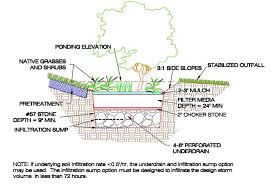 Biochar would also be useful just for its filtering ability in such devices as micro bioretention ponds and ditches. Specifications for these includes 2 feet of sandy soil, but a smaller amount of biochar could provide the same drainage and many times the nutrient filtering of the current designs. It would also yield better plant root growth than just sandy soil.
+Paul Stamets used buried burlap sacks loaded with mycelium to filter runoff from his property. It worked so well, it amazed the government inspectors who came to see the results.
These are all examples of how more effective measures are possible, but not promoted by the bureaucracy, since such official prescriptions such as the Maryland Environmental Site Design Manual don't recognize them. As the 2025 deadline for Chesapeake Bay TMDLs approaches too soon for the counties and states to clean up their watersheds, they are going to want to be able to claim the improvements that mycelium and biochar offer over existing practices.
Subscribe to:
Posts (Atom)
-
A fter reading through most of Cows Save the Planet and other Improbable ways of Restoring Soil to Heal the Earth by Judith D. Schwartz,...
-
I was sold on the garden plot that we began renting last year after spotting a bouquet of oyster mushrooms growing out of an old stump at gr...
-
Lawns do a fair job of capturing runoff, but just putting an average-sized house on a lot can double the amount of runoff from that property...
