Showing posts with label TMDL. Show all posts

Monday, May 16, 2016

Storming and Norming lead to Underperforming

Just from my brief exposure so far, I have concluded that the management of stormwater runoff is typical of our engineered environment in that much effort is put into the design and construction of a device, after which ensues a lifetime of neglect. It's not due to lack of regulation or even oversight, but a lack of attention by owners and a failure of governance. A well constructed stormwater pond can degrade due to erosion, poor control of vegetation, or flowpath blockages and remain that way for years, all the while earning its full TMDL credit, though performing only half as well as it should. The local authorities are loath to penalize or even notify violators of their maintenance obligations out of fear of having a negative economic impact on business. State and federal enforcers are just as remiss.

Now that Environmental Site Design has downscaled the control of stormwater to smaller devices spread throughout a new development site, it will be interesting to see whether things will be better maintained due to aesthetics and scale. Education will be key. Fortunately, the Design Manual spells out the maintenance requirements for each device type.

Here's the type of problems that degrade a stormwater pond. The photo here is from a place I frequent that has not been maintained much for about 5 years. Trees grow on embankments where the roots compromise the dam's ability to hold water. Banks are eroded into the pond, reducing the vegetation inside, causing pooling of water, and reducing the overall pond capacity. Cut trees are left inside the pond, putting more nitrogen into the watershed as they decay. I hope to catalogue many stormwater devices such as this in Calvert County over the coming months and use this in presentations to those who need to know. They will be posted on my newest tab on this blogger site.

Tuesday, May 10, 2016

An Offer You Can't Refuse

Earthworks like swales are ways to direct and slow the flow of surface water, but the low hanging fruit for livestock farmers to reduce nutrient flows into the Bay is installation of riparian buffers. That is, they should build fences to exclude grazing livestock from access to streams. If they want to save on a big fence bill and have an even more helpful result, they should consider rotational grazing. In any case, simple fences that allow wildlife to get through are an important feature.

The Best Management Practice (BMP) with the next highest potential to achieve TMDLs is conservation tillage, which includes no till and minimum till. When you include biochar as a soil amendment (not yet recognized as a BMP, but deserves that distinction), humus formation is accelerated by perhaps a factor of 10. Conservation tillage relies on humus and plants to make up for the absence of artificial soil aeration. As the years go by, such soil-building measures make it possible to reduce fertilizer additions to zero.

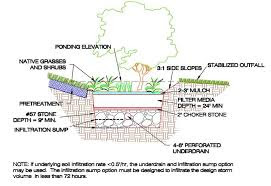
Biochar would also be useful just for its filtering ability in such devices as micro bioretention ponds and ditches. Specifications for these includes 2 feet of sandy soil, but a smaller amount of biochar could provide the same drainage and many times the nutrient filtering of the current designs. It would also yield better plant root growth than just sandy soil.

+Paul Stamets used buried burlap sacks loaded with mycelium to filter runoff from his property. It worked so well, it amazed the government inspectors who came to see the results.

These are all examples of how more effective measures are possible, but not promoted by the bureaucracy, since such official prescriptions such as the Maryland Environmental Site Design Manual don't recognize them. As the 2025 deadline for Chesapeake Bay TMDLs approaches too soon for the counties and states to clean up their watersheds, they are going to want to be able to claim the improvements that mycelium and biochar offer over existing practices.

Saturday, May 7, 2016

Too Big to Swale

Fortunately (and wittingly) we have avoided major overflow incidents from wastewater treatment plants here in Maryland for the past several years. Easier to overlook (and we have) are nonpoint sources of water pollution, which are classified as agricultural, urban, forest, and rural, i.e. septic systems. We have become pretty wise to containing hazardous materials, but the pollutants that are choking our bays and rivers with algae are everyday elements carried in the water seeping through or running over the land. There are over 500 potential water pollutants managed in various parts of Maryland, but one ubiquitous element, nitrogen, is the major problem nutrient feeding the algae invasion of our tidal waters.
Photo by Neil Williamson (CC BY-SA 2.0)
Agriculture is the largest contributor to nitrogen pollution and likely to remain so for many years. This could be because agriculture has consolidated its operations disproportionately to its proper ecological scale. Farms these days, in spite of their vast acreage, are generally family operations. Driven by globalization, agriculture has become a very competitive industry, so much that Maryland farmers would not settle for local administration of their part of the Total Maximum Daily Load (TMDL). They needed more consistent application of the standards that constitute the nutrient diet for the Bay, so TMDL for agriculture is managed at the state level.

However, it is the counties who are responsible for their reducing all of their nutrient flows (including agriculture) below set targets or risk losing their federal funding for infrastructure. In other words, the counties have accountability, but no authority for the behavior of their agricultural sectors. It should be no surprise that they have to shoot beyond their targets in the other sectors in order to make up for the lack of progress by agriculture. (I only have data from St. Mary's County, but am assuming that this subversion of local authority has the same effect everywhere.)

Am I being unfair to the agristocracy? Don't I realize they are working hard to make sure I don't go to bed hungry? No. If anybody has been unfair to them, it's the drafters of the TMDL limits. If those limits are unrealistic or biased, they should be changed. Until then, I'm sticking with my view that Ag is too big to swale and follow other Best Management Practices (BMP's) in fulfillment of their responsibility to help clean up the Bay.


Featured Post

Git 'er Done

By Mark Rain T o get them all done in time to avert ecological armageddon, the thirteen prescriptions for healing the planet offered by...