Showing posts with label compost. Show all posts

Saturday, July 28, 2018

Dining In

Taking the Drawdown list at face value, the 100 measures listed are potential candidates for reducing my family's carbon footprint (including biochar, #71, which occupies so much of my time). Many of the measures do not pertain to someone in my situation. I am owner of only 1 acre, mostly forested, on a hillside in a temperate climate zone. Yet, there are some I can pursue that, right or wrong, are ranked even higher than biochar.

The first is: "#3 - Reduced Food Waste." For our family, there is some room for improvement with this. I am trying to eat what I grow and what I preserve, but sometimes the bounty is too great. I need to give more food away, at least until the quality of my produce will allow me to specialize and sell at farmers' markets. Mushrooms may be the ticket. Oyster mushrooms seem most promising, since I might soon be able to clone great quantities. Foods we don't eat go to composting (#60), so we don't truly waste any of it.

Related to #3 is the next measure on Drawdown's list: "#4 - Plant-Rich Diet." This is a most welcome requirement. I recommend retirement as early as possible, since I have found it allows time for lots of cooking, but even if you can't afford to retire yet, I recommend making cooking a priority. I can hardly stand to eat out anymore; restaurant food is either so disgusting or too expensive, or both.

I say this because last year I discovered a handy feature in some of the cookbooks my wife has purchased over the years, but had never been put to use. The "Taste of Home" annual recipes2018 Taste of Home Annual Recipes
have a special index based on ingredients. It makes it easy to find a recipe that contains what you have on hand. No longer do I bother with questionable online recipes which offer such searches. I just grab one of the dozen "Taste of Home" books on our shelf and find a kitchen-tested recipe that gives me something to look forward to every day. Adding any missing ingredients to our shopping list allows us to buy them anytime we happen to be in a supermarket. As the pantry fills with staples, less and less shopping is needed to make whatever recipes are chosen. By selecting recipes containing produce that we grow, we are able to enjoy amazing food at affordable prices while also achieving measure #3.

Who knew that saving the planet could be so enjoyable?!!

Thursday, July 20, 2017

First Things First

Last night, I was fortunate to hear Dr. Sara Via, a University of Maryland biologist, give her talk on "Ecology of the Soil" to my county's Master Gardeners. She recommended a 2016 paper from Nature entitled Climate-Smart Soils. One of the gems in this paper is the decision tree it offers for the coolest things to do with agricultural land, depending on its nature and condition. It says that marginal lands should be planted in perennials, and histosols (soils containing high organic matter, i.e. former bogs) should be restored to wetlands. Aside from those cases, the paper proffers a hierarchy of various measures that can be taken to improve soil health, such as cover cropping and no-till. The final measure in the hierarchy - adding soil amendments, such as biochar - is not based on the soil condition, but on the availability of the amendment - the more, the merrier (though 2" of compost per year may be a good upper bound).

This decision tree clarifies matters greatly for those who want to practice climate-smart horticulture at any level; from garden to farm-scale. Once I learned about biochar and began making it, my interest in gardening bloomed (along with many more flowers). Along the way, I have learned the importance of many of the other conditional steps in the decision tree that also help to sequester carbon and other greenhouse gases.

Early in my gardening avocation, I was taught that the first thing a landscaper needs to deal with is stormwater. That dictum makes good sense - all the more after getting trained as a Master Watershed Steward. The epiphany for me was that by learning and practicing key disciplines, e.g. stormwater management, composting, and biochar, I would be able to maximize my success in gardening. Similarly, if one wishes to maximize their contribution to improving the climate, there are key practices to follow, depending on the situation. The result, invariably, will be healthier soil - so the payoff and gauges of success are close at hand, though yield increases may not necessarily be as immediate as might be obtained by following ecologically harmful regimens. Dr. Via pointed out that monitoring your soil's health with a do-it-yourself tool called a soil health card is a good way to track progress.

When you take an approach, such as biochar, as the cornerstone of your efforts, it might lead you to wonder how it fits into the grander scheme of climate change mitigations. Project Drawdown's website makes schematics available to assist in that conception. The schematic in the area of Food solutions contains (among other land-use topics) high level categories that encapsulate the decision tree measures just discussed. The Conservation Agriculture / Regenerative Agriculture (CA - Reg Ag) category is particularly germane to croplands. With the guidance of the decision tree above, the soil health card, and the bigger picture of food solutions, my efforts at carbon sequestration through gardening should become even more efficacious.


Monday, July 10, 2017

Drawing Down - 3rd World Style

If  you are the independent type, third world solutions, otherwise known as appropriate technology, can be pretty great. The Drawdown project sees the biggest benefit of small methane generating anaerobic digesters in parts of the world where wood fired cookstoves are commonplace. Distributed digesters in the Drawdown model are fed livestock manure exclusively. Paul Hawkins' group estimates that 36.5% of manure in Asia is currently being run through small digesters and that we can bring that percentage up to 52.6% for all regions of the world where agriculture is dominated by small farms. For the rest of the world, they estimate much greater savings through the use of industrial sized anaerobic digesters. Yet, in marketing their product to the first world, HomeBiogas claims, even without displacing a cookstove, that their food scrap fed digester will save as much GHG emissions as if you stopped driving a car. In my case, it would also save on electricity to run cooking appliances and electricity to cool the house from the heat of those appliances.

Everyone's situation is different, but if you don't rely on a biodigester for recycling your kitchen waste, it may still be better to consider ways to do it yourself - the "it" here being greenhouse gas reduction. Composting of manures, food, and garden refuse are all ways to reduce waste, but they can also reduce greenhouse gas emissions if done properly. The key thing is to keep compost piles aerated. The hard way to do that is by turning the pile frequently enough to avoid anoxia in the pile while also avoiding outbursts of ammonia and methane in the process of turning it. The easy way is by lacing the pile with biochar which is full of microscopic air pockets. I still do some turning and churning of my non-manure compost, but all the piles get about 5 gallons of biochar or more (much more in the case of humanure compost which needs extra pore space in the pile). Sometimes I finish off a pile by giving it time in the tumbler for a few weeks where it gets a lot of air exchange.

If you happen to be a little higher up in the food chain, adding 0.5 to 1% of biochar in the feed for poultry and livestock could reduce enteric methane emissions dramatically. Putting charcoal in feed is not new, but it is being researched more rigorously. The amount of GHG emissions that could be reduced this way is astonishing since it comes with potentially reduced N2O emissions from manure, improved animal health, accelerated feed conversion, as well as biochar's innate sequestration of carbon.

Two solutions you won't find in Drawdown's list are Bioenergy with Carbon Capture and Storage (BECCS) and clean coal. Biomass energy is included as a transitional solution, but does not include any carbon capture, which turns out, like clean coal, to be technically infeasible. If the examples of alternative approaches described above are any indication, however, at the grassroots level, we can still drawdown significant amounts of CO2 by using the means at our disposal. It may surprise many experts to see some of these turn out to be major contributors to limiting global warming.
cells by Penfold_xxx

Wednesday, July 5, 2017

Loosening the Grip of the Grid

One of the distinctions made by zero waste advocates is that incineration of waste to reduce landfill use exacerbates pollution. Waste industry apologists credit Maryland Governor Larry Hogan's decision to withdraw limits on landfill expansion as an effort to avoid shifting the burden to incinerators.

That might be a defensible position if Maryland's landfill gas emissions were well controlled and not the highest human-caused source of methane in the state. Fortunately, the U.S. Appeals Court rode to the rescue in their recent ruling against the EPA's delay tactics on oil and gas well methane emissions. Since the EPA has also postponed the implementation of new landfill gas emissions requirements, expect that the court will also find that decision to be unreasonable, arbitrary, and capricious. More landfills will then be required to incorporate gas collection and control systems. This should serve to pressure states to become more waste conscious.

Waste consciousness should not be left to government regulators. Citizens should police their own waste streams rather than shift the burden to government and industries. Energy and waste management businesses should absolutely be required to cut emissions from their operations, but individual households may find it economical to stop relying on those profiteers and find more DIY solutions.

Such solutions are not hard to find. Humanure composting is not a first world concept, but it makes economical sense. For other organic waste, a quick Google search led me to what appears to be an economical household replacement for capturing landfill gas emissions: a solution that would pay for itself by turning your "waste" into fertilizer and cooking gas. That biogas could also be used to purify water if you add a Stirling engine generator and water distiller, as inventor Dean Kamen and DEKA Research have been doing for the third world with their Slingshot system. The biogas generator may not be functional in the very cold months (though a straw bale enclosure next to one wall of the house might alleviate that), but I would probably only use it for outdoor cooking in seasonable periods anyway. If anyone out there knows my wife, please drop hints to her about what a great invention HomeBiogas is.

Sunday, June 25, 2017

Save up to $100K through this Eco-lifestyle Adjustment

Slums constitute the living arrangement for one-fourth of today's world population. In the least developed countries, those living in slums exceed three-fourths of the population. Any urban area can descend quickly into slumdom when water and sewerage stop functioning. This can happen in any urban environment where the electric supply is lost for a week or where general mayhem prevails. Take Yemen, for instance. Facing a crisis of war, famine, and social collapse, 14 million people there lack access to safe drinking water or sanitation. The conditions are ripe for outbreaks of disease, which is currently appearing in the form of the most massive cholera epidemic this century. 

Cholera is spread by ingestion of Vibrio cholerae, which lives in the water where infected people have released sewage. If not quickly and properly treated, it can cause death in 50 to 60% of those infected. Currently, the number of cases in Yemen is 200,000 carriers of the bacteria. In the 2008 - 2009 Zimbabwe epidemic, the average infected individual transmitted the disease to 1.1 - 2.7 others. Those statistics are the reproduction rate (R0) of the disease. Predictions of 300,000 new cases in Yemen by August must use the lower of these rates.

It is conceivable that conditions in the U.S. could deteriorate to bring about local outbreaks of cholera or one of the other many diseases associated with lack of clean water and sanitation. Sewer systems are susceptible, but a heavy septic system load in a concentrated area could also become a major source. My own neighborhood is reputed to have 70% of its septic systems in a failed condition (my own included) with a 2000% overload to the watershed due to the concentration of homes. 

If you are one of the approximately one-third of homeowners in the U.S. with a septic system, it would behoove you financially to limit your inputs. The typical septic system fails after 15 to 30 years of service. Replacing it might cost up to $20,000 (not to mention the effect of heavy machinery on areas of your property you never planned for). Extending the life of a septic system by using biodegradable soaps and having the tank pumped every three to five years helps, but an unconventional measure that could allow your system to last a lifetime is to not use it for sewage, period. This simple lifestyle adjustment could save you $100,000 over a lifetime.

Loveable Loo - well worth the $400. Detailed instructions included. (An $18 economy unit also works fine.)

Instead of using your drinking water to flush away sewage, take up meticulous composting with your bodily byproducts. Joseph Jenkins tells you all about it in The Humanure Handbook. In the process, do everything necessary to avoid spreading of pathogens to your environment. Don't let your septic system get to the point that mine is, where it is a major health hazard. Humanure composting, even done half well, is better than this. 

Fortunately, when I found out that my septic system had failed, I was already well along with my humanure collection and composting program. With a little luck, I can restore my drain lines to the point that they will drain "greywater" for several more years and all of our sewage will go into the humanure toilets for composting with the biochar, coffee grounds, and small wood chips that I generously smother it with. If you think that sounds slummy, just wait until your community's water or electricity stops flowing.

Friday, September 16, 2016

You Too Can Be A Poop Scooping Pro

My newspaper-lined poop pickup bag method is working fine, but I will admit that, though it works great on a pile of dog biscuits, a fresh specimen of the real McCoy will often deter the most enthusiastic of composters. A day of drying can bring the less manageable nuggets to a condition firm enough to retrieve. Sometimes, when walking Gretchen, I will take a temporary pass on her pungent product and find a firmer one left from another canine in the recent past. It is easy to find these replacements because there are some well known dog latrines on all of our frequent walking routes. In other cases, Gretchen locates them for me.

Leaving my dog's feces on public property, e.g. the right-of-way, is an illegal act punishable by a fine, according to the county animal control regulations, so I would not do this in the public eye. However, if I make a practice of always removing at least one neglected stool from the roadside, I feel like a good citizen. Fines for leaving dog crap lying around in public seem severe, but you could be fined even more (or imprisoned!) for allowing it to accumulate in your yard. I don't know whether these laws have ever been enforced here, but maybe they should.  According to Mr. Dog Poop, the problem warrants even stricter law enforcement.

In order to ensure that I am prepared for my dog walk sanitation responsibilities, I have a kit that should be standard issue for every dog owner. It is easy to assemble, but an enterprising business person could possibly get them out in retail stores, also. The centerpiece is a fanny pack. In it are all of the items that my cleanup method requires. After each walk, I replenish it with the consumable items such as newspaper or bags, as needed. It beats stuffing my pockets with this and that each time I take Gretchen out. With this kit, it's just a quick grab and go.
My dog poop clean up kit includes poop bags, torn newspaper pages, grocery bags, and hand cleaner. A small garden spade or toy plastic beach shovel is also recommended for the impossible grabs.

Tuesday, September 13, 2016

Saving the Bay, One Turd at a Time

I ran into local award-winning environmentalist, +Nancy Radcliffe and shared with her my new resolve for picking up any of my dog's droppings that might cause problems for the watershed. Nancy, who is a leader in the movement to ban plastic bags, suggested that I use newspaper instead of the dog poop pickup bags so freely available. I told her I would do that, so here is the method I came up with. Easier to grasp this idea through demonstration, so a 3 minute video was made. You can tell I'm a little nervous at first, but my voice slows down to a normal timbre at the end.

I jumped on Nancy's suggestion of newspaper as a collection device because it enables easier composting and doesn't waste plastic bags. It is possible to dump a dog turd from a poop bag into a compost bin, but the newspaper allows it to drop out easily and, if you are careful, the poop pickup bag can be used repeatedly.

In an effort to further reduce plastic bag use, I plan to transition to using paper bags to hold the newsprint protected poop. It's just a matter of being particular where I shop and making sure they offer paper bags. I might have to start buying wine by the bottle :).


Saturday, August 27, 2016

September is for Septic Systems

Though I am a septic skeptic, I still depend on my septic system and want to become a responsible system owner even as I wean us off the practice of dumping in our drinking water. I want to encourage others to be responsible septic system owners, too, so I will do what I can to put together an awareness-raising drive with the help of materials in the toolkit provided by the EPA for septic-smart week (Sept. 19 - 23). At least I can put up some posters; maybe do some door-to-door handouts, making initial contact with homeowners who may be good candidates for conversion to humanure composting.

One thing I've never done that the EPA recommends is hire an inspector every three years to see if my septic system is developing problems. Since I have violated several other guidelines over my 11 years of ownership pertaining to protecting the integrity of my system, I may actually have a failed or failing system and not even know it. Most homeowners are probably in the same boat, not even thinking of having an inspection done until it's time to sell. An inspection now may be timely for us in that regard, as well.

Just looking into the topic of septic systems has given me some other useful awareness. I was planning to plant some shrubs over my drain field, and now, having learned better, I'm looking forward to planting self-seeding annual flowers there instead. There might also be a good area near the end of the drain field for my humanure compost bins. If that somehow negatively affects the capacity of the septic system, the reduced load in the tank may be enough to compensate.

Sunday, August 21, 2016

Anti-Septic Solutions

Clivus (pronounced "cleevus") Multrum toilets are a brand of composting toilets that have received the "best available technology" (BAT) designation in Maryland, which means they could be used as alternatives to septic tanks if combined with greywater systems on new construction. They could also allow reduction of septic tank sizes by 30% when installed without a greywater system. If folks want to bypass the 5-year recurring requirement for a groundwater discharge permit, they might try using the composted urine from the toilet as a nitrogen booster to compost high carbon material in a separate long-term, thermogenic compost pile. One drawback to this and other types of waterless toilets that require a vent fan is that you might want to include a backup source of power to keep the fan running during power outages. Another is that it may cost you more to heat and/or cool your home due to the continuous venting through the toilet.

All of this is particularly relevant to someone who has a home in the critical area (within 1,000 feet of a tidal waterbody or wetland) in Maryland. Structures outside the critical area will probably not be subjected to the expense of a change to their septic system, now that Gov. Hogan has announced a turnabout on the mandate for denitrifying septic systems. Homeowners who must still upgrade could take the Multrum toilet/greywater route, though it is not clear whether regulations would still require them to own a septic system and if it would still need to be upgraded. The new tack being taken by the Hogan administration may favor the composting toilet/greywater system option in lieu of costly septic system upgrades. One person I know with a house in the critical area told me his septic system would cost him $20K to upgrade due to the very deep leach field it requires.

The Maryland Department of the Environment (MDE) does not condone the use of compost that is harvested from composting toilets and says that it should be bagged and sent to landfills. There are no laws that specifically prohibit use of this compost on one's own property, though the low composting temperature of Clivus Multrum toilets means that owners should limit the compost use to ornamentals (roundworms being a possibility, and all).

What MDE and the general public need to wrap their minds around is that we must get comfortable with humanure composting. Once you get into compost gardening, you start to realize how valuable and scarce compost is. Compost is also valuable outside of gardening. We are not going to be able to continue the highly polluting practice of synthetic fertilizer production from natural gas if we want to keep from burning up the planet. Christophe Pelletier lays it out for us in economic terms,
In the future, we are going to see a new look at fertilization. The economics of agriculture will change. This is inevitable, because the cost of inputs will increase. This will be a direct consequence of the increase of the price of oil, and of the depletion of phosphates reserves. This change of economics will drive renewed interest for manure, and for sewage. These sources will become attractive and competitive, as they contain large amounts of minerals directly available. Because of their nature, they have a high content of organic matter. One of the most efficient ways to remove nitrates from water is to grow plants with it. One of the main sources of phosphates will be manure.
Now, if manure is going to be so important to growing food in the future, let's not rule out humanure until after a thorough investigation of its appropriateness.

Pelletier weighs the value of manure against the future cost of synthetic fertilizer, but the carbon cost could also be factored in. Compost, in general, can be helpful in reducing greenhouse gasses. The points made by the U.S. Composting Council could be easily extended to include humanure compost.

If the least expensive and most effective method (using a bucket and manually adding your scat to a compost pile) seems too undignified or time-consuming, composting toilets are another option better than sticking with the sewer or septic systems that are currently harming our environment. In Maryland, we are fortunate to have an authorized distributor of Clivus Multrum toilets with plentiful experience.
Compost Fit for a Prince

Thursday, August 18, 2016

No Peaking


The human world's consumption of energy and consequent production of waste heat shown on the graph here reminds me of the microbial activity observed in my compost piles by way of temperature readings. The scale would need adjusting to read in degrees Fahrenheit, but the initial climb and plateau are quite similar. The second heating phase (China joining the world economy) would be analogous to adding another huge batch of well-chopped organic matter to the pile; it brings the temperature even higher, but the effect is relatively short-lived. Once the temperature of the pile peaks at about 160 degrees, the microbial population can no longer tolerate those conditions and there is a rapid die-off causing the temperature to drop to near ambient.
Without resorting to manurial metaphor, Gail Tverberg explains how the current downturn in per capita energy consumption could well continue into a complete collapse of our current way of life. Rather than ascribing the cause to peak oil, as it is usually construed, she explains how demand destruction aggravated by enormous debt could, ultimately, be what drives our economy into ruins.
Industry hacks make lipstick out of oil and put it on the pig of energy production. Mentioning "peak oil" in conversation conjures up the idea of oil shortages, when, in fact, there is no apparent shortage presently. Though the energy quandary the world faces presently was ushered in by peak oil and peak coal, it may be better to side step the cognitive dissonance and characterize the issue as a population problem. Talking in terms of "population overshoot" or "carrying capacity" encompasses all resources, not just energy. It also brings in the even more daunting notion of the developing latest extinction of the biosphere.
Upon hearing the vision statement of a big ag oriented talk on the state of agribusiness in Maryland, I raised the question of whether the authors' views of a foreseeable future took into account peak oil. The answer was no, which led me to take many of the conclusions presented with a grain of salt. Later, in a different context, I brought up the importance of preserving biodiversity in Calvert County, which raised more discussion, but my earlier peak oil concern never got much air time. 
Raising the carrying capacity flag, rather than the peak oil flag, implicitly postulates a global context. The term is more immune to dismissal by our inured belief that substitutes can be found for everything, because it implies that limits exist. Peak oil is usually discounted by the idea that additional peaks in newly exploited resources will come along, as needed, to endlessly boost total energy production. However, pointing out that we need to withdraw our footprint from half of the earth's surface if mankind is to have a chance at a secure future brings the scope of the problem into clearer focus and sets the context to address planning in the light of population overshoot and carrying capacity. 
Jumping down from a global scale, solutions can be cast in a local frame since ecosystems function globally, continentally, regionally, locally, and microscopically . Hence, in the discussion of the future of agriculture in Maryland, a renewed program to preserve and restore wilderness in our county makes sense, though it would likely reduce land available for agriculture. This would push us to more intensive and careful stewardship of land resources, whereas peak oil, of necessity, pushes us toward smaller, more localized agricultural enterprises. Either way, we end up with a vision far different than the one proffered by big ag advocates.


Sunday, August 14, 2016

Local Legalities wrt Reducing Septic Tank Usage

The Chesapeake Ranch Estates (CRE), where I live in Lusby, Maryland is a good place to promote humanure composting. Every one of our 4,000+ unique single-family dwellings is connected to a septic tank. About one-tenth of our residences are in the critical area, magnifying, manyfold, their potential for polluting the Bay. The EPA standard for septic system density is at 40 systems per square mile, an area's groundwater is most likely being overly contaminated. CRE's septic system density is around 900 systems per square mile.
"Stoplight, Septic Truck, and the Sea" by C.C. Chapman
Calvert County's phase II Watershed Implementation Plan (WIP) to help reduce pollution of the Chesapeake Bay watershed is relying on a few demanding measures to improve the nitrogen removing performance of septic systems. By installing denitrifying septic systems, they can eliminate up to 93% of nitrogen discharge to the watershed from those sites. The government's cost to execute the WIP will require double the current budget, but a lot of the cost will be borne by homeowners who would have to install the improved systems at costs up to $12,000. Failed septic systems, new systems, and existing systems belonging to homes being sold would all require the expensive new technology. The WIP says nothing to encourage alternatives such as composting toilets.

The Maryland Department of the Environment makes the composting toilet alternative only mildly attractive by allowing a dwelling's septic system to be sized about 1/3 smaller.  The regulations only address waterless toilets in the context of waste disposal. In particular, they address “On-site disposal” which they define as "the disposal of sewage effluent beneath the land surface." They also levy additional permitting and inspection requirements on owners of waterless toilet systems that dispose of the sewage on-site. The whole process would appear to drive the on-site disposal alternative into the loss bracket for most homeowners.

The regulations do not delve into the possibility of recycling the manure through thermogenic
Photo by Scot Nelson
composting in bins above the ground. With that approach, once it is fully composted and cured, the material is no longer "sewage" and applying it to gardens can't be properly described as "disposal." The absence of regulation on this topic leaves it up to the citizenry as to whether they recycle their excreta, though there may also be local rules to deal with. My guess is that the county would jump at the opportunity to take nitrogen credit for hundreds of households that have stopped flushing toilets into their septic tanks and, instead, make water purifying compost out of humanure.

Monday, June 27, 2016

Sunshine Insurance

Composting biochar and digging it into the soil before planting is a best practice that needn't be followed in all situations. When mulch is needed, especially for warmth-loving plants, biochar could be a better choice than straw or other common dressings. As I pointed out in my previous post, this mimicking of a natural fire's residue gives the biochar an opportunity to become somewhat charged and inoculated while holding moisture in the ground.

My pepper plants basking in the heat from a top-dressing of biochar and black plastic
Plants need three things to exist: Nutrients, Water, and a suitable atmosphere that contains Light. Charging biochar with nutrients and getting it wet make it an excellent buffer for the first two needs. For the sake of completeness, I've been trying to imagine how biochar could also buffer a plant's need for light, allowing it to make sugar without total reliance on photosynthesis. If it does this, it would be by use of an alternative energy source, e.g. electric current.

The discharge of electrical currents around plants is touted by some to aid plants in many ways, including improvement of their capacity for photosynthesis. Or perhaps, rather than using light in conjunction with chlorophyll, plants can use electricity through their roots to power the transformation of CO2 and water into sugar.

Biochar has a quasi-graphene micro-crystalline structure that could make it able to generate photoelectrons by sunlight impingement, which it might then store capacitively until its conductivity is raised by filling with rainwater, allowing the electrons to discharge into the ground. Alternatively, rain could deposit cations on the graphene-like micro-crystals to trigger current. In these ways, biochar top-dressings might act as a photosynthesis buffer on rainy days when sunlight is lacking.

These conjectures enable me to maintain the notion that biochar can provide assurance of plants' three essential inputs. If biochar provides sufficient assurance, then maybe the government will see fit someday to subsidize farmers with biochar instead of crop insurance.

Now, (speaking of assurance) I doubt that exposure to the elements is going to fully prepare biochar for incorporation into the soil over a single season. Using a 50-50 mix of compost and biochar as a top-dressing, however, might be just the ticket.


Saturday, June 18, 2016

Geoengineering Your Garden

Photo by YoungToymaker
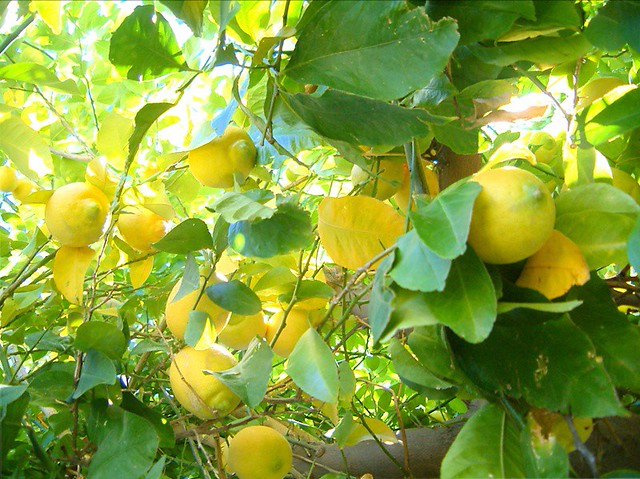
When life gives you liminality, make lemons or some other subtropical (or even tropical) fruit. For us here in hardiness zone 7, climate change will probably have us in zone 8 in a decade. My palm trees and peaches will feel right at home. To grow citrus or bananas, however, a little geoengineering will be needed by way of tweaking areas of our property where the microclimate can be pushed a bit further in the warm and humid direction. In Paradise Lot, +Eric Toensmeier and +Jonathan Bates offer many suggestions on expanding your hardiness zone.

Raingardens, ponds, and swales all contribute to higher ground-level humidity. Our future hops vines, growing at a angle to a height of 35 feet should also create a quasi-greenhouse beneath, especially with the compost pit dug into the ground near their base. We also want to leverage warm, sunny spots created by South-facing walls as good areas to tropicalize.

And for that, we have a secret ingredient. Biochar, with its low reflectivity, is a great infrared energy absorber, warming the soil. It also holds about 3x its weight in water. The elevated temperature and moisture create a high humidity zone in the immediate airspace above high biochar concentrations.

My tomatoes and peppers grow prolifically, in part, due to top-dressing with biochar. Where I have cut holes in the black plastic, I mulched with biochar to prevent weeds, capture moisture, discourage pests, and further decrease albedo. I add extra organic fertilizer when it's time to feed the plants, in order to adjust for the nutrient sink created by the biochar. Next season, the biochar will be already charged and populated with soil microbes so that it can be dug in and do long-lasting service in the ground. I prefer this technique over composting of biochar, as it saves time and effort (though compost plus biochar is a superior soil amendment).

Maximizing the biochar concentration in garden beds (up to 50% of soil volume) will produce similar results. The terra preta effect will move your garden to more equatorial climes. We have a lime tree that's been container-grown for 12 years, but one day it might find its place in the sun where the snow never sticks.


Sunday, April 24, 2016

Beyond Chemicals

While I see a need to have soil restoration promoted in the next version of the Calvert County Comprehensive Plan, there are already many elements of the plan and ongoing institutions promoting soil conservation. The Comprehensive Plan includes "Sediment flows from development and farming" as a threat to the vision that
Our wetlands, streams, and forests support thriving plant and animal communities.
The corresponding action is "Develop soil conservation and water quality plans for farms."

When you look into the Best Management Practices of the Soil Conservation District, it appears that they have this whole issue pretty well in hand (at least among the farms on the list of cooperators). Many of these best practices lead to soil restoration in addition to soil conservation. At least one of the BMPs, however, is potentially counterproductive - that is, perpetuation of chemical fertilizers.
Photo by Paul Riismandel (CC BY-NC-SA 2.0)
The problem with chemical fertilizers is that they can reduce the soil biota population below a critical level where the microorganisms make the soil ecosystem work in the plants' favor. This results in the need to use more fertilizer to achieve the same results as in previous years and the soil undergoes a death spiral until it is no longer economical to farm.  Many of the trace nutrients used by plants are generated by the proliferation of soil microorganisms and could be uneconomical to add directly as we do commonly applied macronutrients like Nitrogen, Phosphorus, and Potassium (N, P, K).

It may be possible to restore soil humus by intensive farming methods while still using chemical fertilizers, but a surer method is to farm organically using biochar, compost, and organic fertilizer, as necessary. The goal should be to eliminate fertilizers altogether in favor of creating humus which is self-regenerating as long as crops are grown successively and rotated from year to year. Our farmers, large and small, need to learn to do this if for no other reason than that chemical fertilizers are a nonrenewable resource. A better option, still, is to grow perennial food crops. While we're at it, let's take advantage of soil carbon restoration for its role in cooling the planet.


Thursday, February 25, 2016

Oyster Farms on Land

Let me clear up some common misconceptions about mushrooms. We used to have a saying in the Navy, that the Combat Information Center (CIC) watch was like being a mushroom, since we were always kept in the dark and fed sh*t. The truth about mushrooms is a little more nuanced. Yes, they do enjoy shade, but most tolerate a bit of direct sun, and most grow in the soil or on wood, though some are cultivated in manure or compost.

It's the manure part that bothers people, leading them to eschew mushrooms. In fact, I'm not particularly thrilled about buying button mushrooms from the store, seeing all the growing media residue still clinging to them. Thing is, the manure, if used, was probably composted and possibly topped by a pasteurized,non-fecal casing soil to remove pathogens and interfering fungi in the process of being implanted with the fungus you'd be eating. That's better than you can say for the soils that grow many of your vegetables. Farmers often apply manure to their soil, allowing as little as 3 months for natural processes to kill off pathogens before harvesting the crop. So, wash your vegetables, as well as your mushrooms, before cooking or consuming them.

We could do better by the Bay than to spread manure on farmland. About 20% of Maryland farms are restricted in the types or amounts of manure they can use now because of the Phosphorus Management Tool (PMT) regulations. Phosphorus is an important pollutant to manage, but Nitrogen is also a growing concern, having negative impacts on at least 5% of affected ecosystems' endangered species. Much of the sandy soils in the Coastal Plain don't accumulate nutrients and pass them through quickly to aquifers and waterways. Rather than base manure application limits on soil phosphorus content, we should be looking at nutrient flows.

One of compost's key characteristics is that it holds on to chemicals, such as phosphorus, acting as a filter in the soil to limit the amount of nutrients that make it through to the Bay. The same can be said of biochar and mycelium, but to an ever greater degree. Blaming the PMT on the decline in the number of Maryland farms ignores the whole issue of nutrient pollution, while the PMT ignores the flow of nutrients from the soil. Adopting a more rigorous protocol for reducing nutrient pollution seems to be warranted, but we need to avoid burdening small farms with added costs and management effort. Options in the PMT for measuring reductions in actual pollution to waterways, rather than strict limits on fertilizers, could be the way to go.

Of all the methods mentioned, I think mycelium is the most promising (though farming with biochar would do enormous good). In Mycelium Running: How Mushrooms Can Help Save the World, Paul Stamets discusses implanting bunker spawn in trenches to filter runoff from areas of concentrated pollution. I'm starting to do this on my own property as I acquire mycelium in my various experiments.
Oyster mushroom mycelium is supposed to be good for this use. Once the mycelium is established it can flourish, if fed new wood chips occasionally. The great thing about it is that farmers could harvest and sell the highly nourished oyster mushrooms that would grow out of these mycofilters.

Tuesday, January 26, 2016

Accelerating Eden

Biochar will accelerate formation of topsoil, but ten years is a long time to wait. In my ignorance, five years ago I set up two garden beds using the native loamy sand that remained after our property addition was leveled. The results were so meager that forest vermin weren't even stopping by for lunch. The next few years were progressively more productive after successive additions of compost and biochar enriched the channery soil. Last year, I decided to expand with a new bed by using a method known as lasagna gardening. Also known as sheet mulching, lasagna gardening entails putting down layer after layer of organic matter on top of a poor growing surface, then waiting six months for it to break down enough to plant.  The up front work was considerable, but I was well rewarded with a bed that was more bountiful than the two that had been enriched year-by-year with biochar and compost.  (Biochar and compost were also ingredients in the lasagna garden.)  The takeaway is that, with poor soil, you don't have to wait ten years for a productive garden. You still have to add layers to a lasagna garden every year and dig it all in, but if biochar is included, even that can cease after ten years.

This year, I made two beds using sheet mulching and a very deep compost bed, following the same approach, in which I plan to grow mushrooms. My future forest garden patches will be grown out of sheet mulch, also. Perhaps the hardest part about lasagna gardening is getting enough of the right ingredients, green material, in particular. I've had to reach out to acquire enough of this high nitrogen material for my beds. I collect buckets full of used coffee grounds from a local doughnut shop and tons of horse manure from a local stables. It is best to pre-compost manure with straw or other brown material, before adding to the lasagna garden, in order to kill pathogens by the heat of composting. I'm looking at integrating my acquisition of green material onsite through raising chickens. Geoff Lawton explains how.

Friday, November 20, 2015

Chicken Shit

Turning our gaze across the Chesapeake Bay where chicken factories are one of the salient features of the landscape, a group of activists called Food & Water Watch has raised protests against the incineration of chicken manure.  You might think, with my advocacy of using chicken litter to make biochar, I would take exception to that position.  The truth is, incineration is not how you make biochar.

F&WW seems to mainly want to make CAFO's go away, but their agitation against the Renewable Fuel Standard inclusion of manure as a Tier 1 renewable fuel is ostensibly based on increased air pollution from incineration.  A long and twisted tale leads to the current state of dissatisfaction over the way we deal with this resource.

We can begin with Martin O'Malley who, back in his days as Maryland Governor, made a deal with Exelon Corporation to fund $50 million of a project to convert chicken litter to energy in exchange for allowing them to merge with Constellation Energy.  The company that got the award to head up the manure power project, Green Planet Power Solutions, failed miserably.  Now, other players are hoping the money is still there for a more competent outfit to give it a try.

In the meantime, the Maryland Department of Agriculture has begun to assist poultry farmers with a much smaller pot of money under the Animal Waste Technology Fund.  A company called Renewable Oil International MD, LLC has been granted $1.2 million in support of developing a manure-fed energy system that makes biochar as a by-product.

The major action, however, is where a company called AgEnergy USA is talking with Perdue about making a $200 million manure-fired energy plant.

Biochar has been little but an afterthought to some of these projects, which leads me back to the F&WW argument.  Biochar is not made by incineration, but by pyrolysis, of which a particular method is gasification.  Pyrolysis involves heating material in a oxygen-deficient environment.  That means less NOx is produced and particulate matter is also kept low, depending on the speed of the process.   F&WW should like that.  I hope they do, because I think I like Food & Water Watch and would like to link arms with them to work for more local agricultural systems.

Tuesday, November 17, 2015

Dregs

An encouraging trend in Maryland and much of the country toward more local self-sufficiency is the explosive growth of local beer brewing.  Even more encouraging is the 2012 passage of a law here that allows farmers special dispensation in order to brew and sell beer and other accompaniments. This reduces the logistics of delivering agricultural inputs to the brewers.  I noticed one such farm brewery close by that I would like to visit someday.  Calvert Brewing Company makes several types of beer, with their webpage telling you which types of hops go into each one.

Therein lies my interest; not so much in the drinking, but in the ingredients.  A few weeks ago, I introduced myself to the brewmaster at The Ruddy Duck Brewing Company in order to inquire as to the chances of relieving him of some of the spent grains used in making his beer.  He was happy to oblige.  I now bring him a 30 gallon container every week, which he fills with wet hops and grains out of one of his tanks.  He also gives the stuff away to a couple of local farmers.  They use it as a feed supplement.  I use it in compost (my dog won't eat it).  I do the same thing with 5 gallon buckets of coffee grounds that I get from the local doughnut shop.  Starbucks will give away big plastic trash bags full of spent grounds, so you don't even need to leave a bucket - just ask whenever you visit.  All this collecting activity is incidental to other errands nearby - same with the horse manure and the bags of raked leaves I grab from friendly neighbors who would otherwise pay for their disposal.

Of course, I collect my own leaves, coffee grounds, and dog manure (see previous post), but the volume is an order of magnitude higher with these other sources.  If I ever start home brewing beer, I will also be using the mash for composting, or perhaps for feeding chickens. As a first step, I will try growing some of the varieties of hops used by The Ruddy Duck or one of our other local breweries, in case they would like to buy them from me.

Saturday, November 14, 2015

(Sh)it's All Good

Avian flu is not the only disease that might come from raising chickens.  The common concern is e.coli. Some 60,000 cases of e.coli infections get treated every year in the U.S. and a few deaths do occur, but, though those rates are low, who wants to be sickened by some nasty bug?  Nasty, because the main source is animal excrement.

I could say "shit," but that's not what it is to me.  I treasure it and all other excrement because, in a display of nature's alchemical capabilities, crap can be transformed into black gold through the phenomenon of composting. There are several types of dung I currently collect. We have a backyard chicken owner in our church who lets us take their droppings to our community garden for fertilizer. I regularly visit a riding stables about 3 miles away to fill bags with horse dung and cart them home for composting.

Anyone who has pets can also compost their caca with a little forethought.  I bought a cheap, versatile Geobin composter for the sole purpose of composting the dog mess I clean up weekly. I now look forward to making those weekly rounds, especially with the handy, lightweight poop scooper my wife got for my birthday present. The warnings you hear about keeping pet poo out of your compost bin are valid.  However, once the segregated pet droppings undergo thermogenetic composting at 140 F or higher, and then remain in a pile for a year, they are safe to use in ornamental gardens.  It's this short heat and long cure cycle that keeps the risk of e.coli and numerous other pathogens low. In order to keep the pile from reeking, I simply layer sawdust on top of each week's deposit. I also add meats, fats, and bones from our kitchen scraps to the middle of this bin - another no-no for general composting.

The same approach can even be used for humanure, which requires more planning, preparation, and particularity.  The bins should be built to higher standards, a collection system is needed, and odor control must be thorough.  I'm not there yet, but am headed there.  It's not just about making better soil, it is also about protecting the environment.  Our current sewage systems don't do a good job of this.  Less is more when it comes to giving doo-doo the treatment it deserves.

Maryland's big business-friendly governor doesn't make those Eastern Shore farms compost chicken fecal matter before spreading it on the land.  Yet, another way to deal with pathogens from poultry litter is to make biochar out of it.  There is actually some governmental funding being applied to building up this capability for the sake of the Chesapeake Bay.  Biochar has also recently been ascribed the ability to sequester not only carbon, but e.coli as well.  Simply adding biochar to the soil can protect crops from carrying such pathogens.  It seems that combining thermogenic composting of any form of manure with only 10% biochar by volume would make the resultant product quite safe and result in a double win for the environment.

Monday, October 19, 2015

Fall Undertakings

Though wood chips are available here year-round, a more compostable product of nature is offered only once a year.  When the leaves fall in the Fall (get it?), we have some choices to make.  Are we going to blow or rake them off to the side? bag them? shred them first? and then what?
Any of those three options are fine, it's the "then what?" that makes the difference.  If you leave them on the ground off your lawn, they will eventually decompose and nourish the soil there.  If you bag them, then add a little rich soil or compost, slash the bags in several places, and plan on turning them every month for a year, you will then have leaf mold that can be used as a mulch or compost input. If you shred them, then use the shreds as mulch or as a compost input.
Speeding up life and death's natural rhythm always takes exertion, as I demonstrated yesterday at Double Oak Farm when I made 25 gallons of biochar during the Calvert County Farm Festival.  In our area, the most prominent exemplar of leaf composting is found in the two counties immediately north where they make Leafgro from leaves and grass clippings.  It makes a good soil amendment, but you can make better if you include food wastes and biochar in the compost you make yourself.  After my exertions at the demo yesterday, I am glad to know that some people are getting the biochar bug along with me down here in Southern Maryland.  Maybe someday, we can get enough interest to mass produce a biochar compost product to rival the popularity of Leafgro in this region.  One company has actually beat us to market and are beginning to penetrate our area with it.

Featured Post

Git 'er Done

By Mark Rain T o get them all done in time to avert ecological armageddon, the thirteen prescriptions for healing the planet offered by...