Showing posts with label global warming. Show all posts

Saturday, July 28, 2018

Dining In

Taking the Drawdown list at face value, the 100 measures listed are potential candidates for reducing my family's carbon footprint (including biochar, #71, which occupies so much of my time). Many of the measures do not pertain to someone in my situation. I am owner of only 1 acre, mostly forested, on a hillside in a temperate climate zone. Yet, there are some I can pursue that, right or wrong, are ranked even higher than biochar.

The first is: "#3 - Reduced Food Waste." For our family, there is some room for improvement with this. I am trying to eat what I grow and what I preserve, but sometimes the bounty is too great. I need to give more food away, at least until the quality of my produce will allow me to specialize and sell at farmers' markets. Mushrooms may be the ticket. Oyster mushrooms seem most promising, since I might soon be able to clone great quantities. Foods we don't eat go to composting (#60), so we don't truly waste any of it.

Related to #3 is the next measure on Drawdown's list: "#4 - Plant-Rich Diet." This is a most welcome requirement. I recommend retirement as early as possible, since I have found it allows time for lots of cooking, but even if you can't afford to retire yet, I recommend making cooking a priority. I can hardly stand to eat out anymore; restaurant food is either so disgusting or too expensive, or both.

I say this because last year I discovered a handy feature in some of the cookbooks my wife has purchased over the years, but had never been put to use. The "Taste of Home" annual recipes2018 Taste of Home Annual Recipes
have a special index based on ingredients. It makes it easy to find a recipe that contains what you have on hand. No longer do I bother with questionable online recipes which offer such searches. I just grab one of the dozen "Taste of Home" books on our shelf and find a kitchen-tested recipe that gives me something to look forward to every day. Adding any missing ingredients to our shopping list allows us to buy them anytime we happen to be in a supermarket. As the pantry fills with staples, less and less shopping is needed to make whatever recipes are chosen. By selecting recipes containing produce that we grow, we are able to enjoy amazing food at affordable prices while also achieving measure #3.

Who knew that saving the planet could be so enjoyable?!!

Tuesday, July 17, 2018

The Coming Scramble for Survival


Necessity is the midwife of devolution. Invention's mother is running out of resources, so she is reverting to the tried and tested. Her next brood will be a passel of low-tech survival tools. System design and implementation takes about a decade and that is about all the time we have before nature puts her foot down (if the rate of Arctic sea ice melt is a reliable leading indicator). The rate of ocean warming will increase promptly after the ice is gone. Coastal cities will experience a markedly more rapid increase in flooding events. It will finally become clear to the man on the street that we haven't done what it takes to turn the tide and cannot spend another decade working on it. The new systems that we could have had ready to withdraw CO2 from the atmosphere will not be available in sufficient quantities to prevent a great die-off. Suffering will move people to act individually and locally and one of the only negative CO2 tools available to the average Joe will be the biochar that they can make on their own. Enduring the diminished resource future will, however, carry the built-in solution of doing less of what has long been damaging the climate. 
Below, a list from Drawdown.org shows 71 solutions before it gets to biochar, about one-third of which are scalable to the human individual level. Collective activity won't entirely cease and the ultra-wealthy will still be able to command some sizeable projects, but beyond what takes place in the next few years, there won't be much civic initiative to avoid the continuation of today's burgeoning apocalyptic chain-of-events. Debt levels keep rising and all it will take is a crisis for everything to collapse in a way that will take a century or more to heal. Some places "get it" more than others, though, so living in a state governed by the cognoscenti may allow some of today's heroes to continue a more efficacious collective fight against global warming into the next saeculum. If so, a few people may survive to perpetuate the human species.
1
2
3
4
5
6
7
8
9
10
11
12
13
14
15
16
17
18
19
20
21
22
23
24
25
26
27
28
29
30
31
32
33
34
35
36
37
38
39
40
41
42
43
44
45
46
47
48
49
50
51
52
53
54
55
56
57
58
59
60
61
62
63
64
65
66
67
68
69
70
71
72
73
74
75
76
77
77
77
78
79
80

Sunday, May 20, 2018

Going Tropical

I've got rain on the brain. After listening to a local presentation last week on "Gardening in a Changing Climate," the monsoon arrived on cue. We have received 15" of rain in the past week. Normal is 4" for the entire month. More intense storms are an expected consequence of global warming and increased rainfall in the Mid-Atlantic states is the general outlook from climate models.

Time to brush up my knowledge forest gardening, but more particularly agroforestry (or its more ecological cousin, climate eco-forestry). Trees need a lot of water and, with our increasing rainfall, growing trees should be easier here. Ironically, my understanding of sustainable forestry leads me to conclude that I have too many trees growing on most of my property. That is, they, like people, over-propagate when left unattended, making life more difficult for all of them. Culling selected trees to grow mushrooms and make biochar will open up space for many of the more desirable trees and for planting new species.

The species added could be selected for their usefulness as food, lumber, fuel, or in making biochar and even bio-oils. All of these have potential to draw down atmospheric CO2. For example, according to a 2014 study, building with wood could reduce annual global emissions of carbon dioxide by 14 to 31 percent. Another, more recent, study estimates that drawdown to the 1.5 ⁰C increase stated as the Paris agreement goal is completely within the capacity of a biocarbon-producing world if everyone does their part with the land under their care. According to Project Drawdown, an acre of multistrata agroforestry can achieve rates of carbon sequestration that are comparable to those of afforestation (ranked 15th by Drawdown ) and forest restoration—2.8 tons per acre per year, on average. This fits my situation well, since multistrata systems are well suited to steep slopes.

My choice for a biocarbon crop might be bamboo. According to Albert Bates, bamboo is the second fastest growing plant on Earth, after microalgae. It will double its biomass every year if conditions are right. Running varieties can expand as far out from their base in one year as they are tall, and do it again the next year, and the next. Some edible shoot running types that would be good in zone 7b are the 10' Chishima-zasa (Sasa kurilensis) and the 30' Sweetshoot Bamboo (Phyllostachys dulcis).  They grow in full sun or partial shade and make great barriers - just the thing to avoid panic attacks by neighbors over distant sightings of my flame cap kiln or TLUD oven in operation.

Thursday, November 9, 2017

AFOLU

Leading up to COP-23 being held this week in Bonn, Germany, a flurry of reports on climate progress and solutions have been released by NGOs and governments. Drawdown was one of the early arrivals, but in the past couple of weeks, we have seen the annual Countdown report by The Lancet, a National Academy of Sciences (U.S.) report called Natural Climate Solutions, the fourth U.S. National Climate Assessment (Vol. 1), and the eighth annual Emissions Gap Report by the UN Environmental Program.

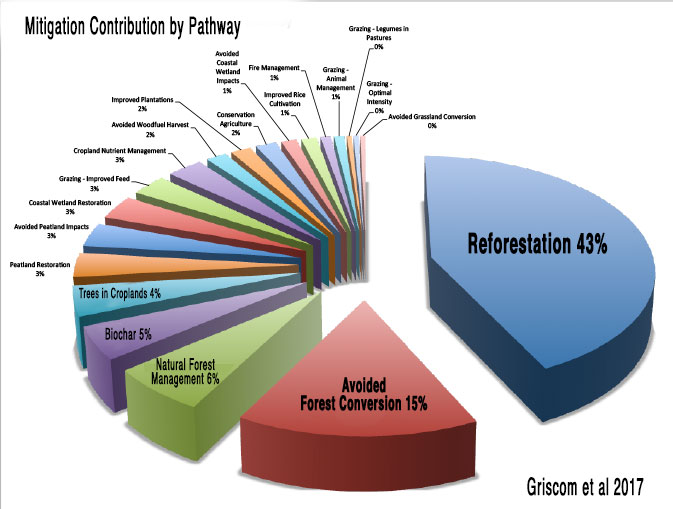
Of these, I gravitate toward Natural Climate Solutions, which is an independent update of work included in IPCC Working Group III (WGIII) for the greenhouse gas inventory sector referred to as agriculture, forestry, and other land use (AFOLU).  +Albert Bates offers a good case for prioritizing NCS, predicated by the understanding that these ecosystem solutions are only a small part of human activity required to prevent climate chaos. In NCS, as opposed to other remedial efforts, nature cooperates in restoring climate equilibrium, though humans, in their proper domineering role, intervene to initiate and manage that renewal.

Biochar, my chosen interest, ranks pretty high among NCS solutions, despite use of much lower estimates than scientists have offered. The NCS authors took pains to ensure no overlap when they compiled these, but in doing so, probably missed some synergies, partly because biochar is not just good for thirty years, but for hundreds of years. For biochar, synergies are possible with fire management, improved forest plantations, reforestation, trees in croplands, improved feed, crop nutrient management, conservation agriculture, and rice cultivation.

Granted, the problem we face must be dealt with quickly, but a long view puts the carbon net present value of biochar much higher than such a crisis management evaluation would include. For example, suppose reforestation included soil-ready biochar in the initial planting and added to the periphery of each tree's root tips each year for thirty years. That tree will likely grow healthy and live a hundred years or more, with larger and more plentiful roots, sequestering much more carbon than trees absent biochar. Those synergies were not assumed in the reforestation category or the biochar category. Another example of synergy, regardless of biochar's longevity, is the use of beetle-killed trees in providing biochar feedstock. This make biochar production more economical and helps with fire management and natural forest management.

Though synergies aren't accounted for in the NCS estimates (but possibly inadvertently included in the uncertainty ranges), they are still acknowledged in the larger sustainability context. The Nature Conservancy's summation concludes:
Most nature climate solutions—if effectively implemented—also offer water filtration, flood buffering, improved soil health, protection of biodiversity habitat, and enhanced climate resilience.
“The approach is synergistic,” says Justin Adams, managing director for Global Lands at the Nature Conservancy. “We can hit multiple targets of the UN Sustainable Development Goals if we get this right.”

Thursday, October 12, 2017

Welcome to Disasterland

I was talking to Colin, my next-door neighbor, yesterday about the impact of Hurricane Irma on the Everglades. As a U.S. Park Service biologist, Colin has spent many hours in the Everglades. He  unequivocally stated that the wildlife in the Everglades was seriously harmed by Irma. Yet, the Everglades took the hit for much of the human habitation on Florida's west coast. In a few decades, that won't be the situation since the Everglades will be swamped by rising seas.

Irma was a big hurricane that could have caused a lot more damage, especially if it had tracked up the eastern side of the state. As it turns out, the cost is estimated at $60 billion, yet we haven't figured in the cost of ecosystem damage that, due to threshold effects like loss of the entire Everglades, will precipitate from this and subsequent storms and temperature rise.

Ecosystem services aside, the cost of natural disasters is increasing. Driven in large part by overpopulation and also by global warming, the cost trend has been swooping upward over the past several decades. The relevant graph in the preceding link is the one above the caption: "Overall losses and insured losses 1980-2016 (in USD bn)." It shows trend lines for uninsured and insured losses superimposed over the loss figures for each year. 2017 looks like it will be consistent with that trend.

A dramatic graphic that shows how 2017 is shaping up in the U.S. came out after Hurricane Harvey. Since then, we've had Irma, Maria, and wildfires in California. Note that the yellow semi-circles on this reticulated timeline, denoting wildfires, are the second biggest in terms of average cost per occurrence. My guess is that one yellow semi-circle this year will exceed any on this chart.

Figures that put Harvey and Irma together at $150 billion are enough to nearly exceed the global total of losses for 2016. Maria, the Mexico earthquake, California's fires, and who knows what else will send 2017 way over that mark. Markets may falter as the effects compound. My prediction made three years ago of a major financial seizure in 2017 could well turn out to be accurate.

Richard Heinberg sees, in Puerto Rico, a teachable moment about how the limits to growth will eventually treat all places in much the same way as Maria did P.R., forcing us all to adjust our thinking about what is achievable and sustainable. We may not all be made homeless by wildfires, hurricanes, or earthquakes, but we will still suffer from collapse of financial and infrastructural systems we have come to rely upon. Take heed and prepare for a simpler way of living.

Photoshopped photo by Elliot Margolies


Featured Post

Git 'er Done

By Mark Rain T o get them all done in time to avert ecological armageddon, the thirteen prescriptions for healing the planet offered by...